From Paper Piles to SQL Queries: Modernizing a Hospital Database with SQLite

The Challenge: A Hospital Drowning in Paper
When I started my database project at ALX Academy, the brief was simple yet daunting: help
Mnene Hospital transition from a traditional, paper-based record system to a modern digital
database.
- Mnene Hospital is a vital community pillar, but their reliance on physical files caused headaches
every single day:
Slow Care: Nurses and doctors wasted critical minutes searching through filing
cabinets, delaying patient care. - High Risk: Paper records are vulnerable to loss, damage, and security breaches.
- Operational Drag: Administrative staff spent more time managing logistics than.focusing on patient services.
My goal was clear: design and implement a robust digital solution that would streamline
operations, secure data, and ultimately, improve patient outcomes.
The Solution: Building a Digital Foundation wit SQLite
I chose SQLite as the core database engine. Why? For a project focused on proof-of-concept and demonstrating data structure, SQLite is perfect: its lightweight, easy to deploy, and fully capable of handling complex relational data while proving the systems viability.
The database was structured around the hospital’s core entities:
- patients: Comprehensive demographic and contact information.
- doctors: Doctor names, specializations, and IDs.
- appointments: Linking patients and doctors, tracking ailments, dates, and status.
- admissions: Tracking patient stays, admission/discharge dates, and status.
The Power of SQL: Data-Driven Insights
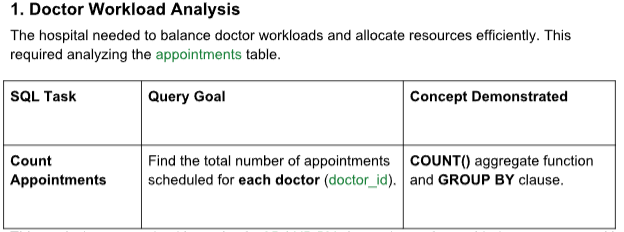
A database is useless without the ability to extract meaningful information. The real
demonstration of value came from executing complex SQL queries to solve specific operational
questions the hospital needed answered.
Here are two key tasks that transformed raw data into actionable intelligence:
2. Operational Efficiency: Measuring Length of Stay (LOS)
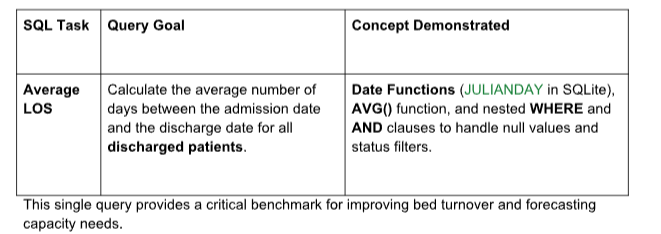
A crucial metric for hospital efficiency and resource planning is the average length of stay
(LOS) for patients who have been discharged. This task was challenging because it involved
date arithmetic and filtering for specific status values.
Technical Takeaway: Beyond the Project
This project, which you can explore on my GitHub, is more than just a set of SQL scripts; it is a
full-cycle demonstration of foundational data skills:
Database Design: Translating real-world business requirements into a logical,
normalized schema.
- SQL Mastery: Using aggregate functions (COUNT, AVG), conditional logic (WHERE),
and grouping (GROUP BY) to derive business insights. - Problem-Solving: Directly addressing operational inefficiencies with targeted data analysis.
By successfully deploying and querying the Mnene Hospital Database, I validated my ability to
use data management principles to solve complex, real-world organizational problems—a skill
set that is essential in any modern workplace.
You can view the full repository, including the database file, all query scripts, and execution
screenshots, here: Check the on GitHub